ENTERPRISE CASE STUDY
Invoice Processing Solution Design
A proposed accounts-payable automation platform using DocuWare as the document system of record, with OCR and AI-assisted extraction under business-rule and human controls.
Domain
Finance and Accounts Payable
Timeline
Proposed solution design
Architecture Role
Enterprise Automation Solution Architect
Deployment Status
Business case and proposed architecture
Accounts-payable teams may re-enter invoice data by hand, reconcile purchase orders manually and chase approvals over email. This contributes to slow processing, data-entry errors, duplicate-payment risk and limited operational visibility.
Use DocuWare to capture and manage invoice records, an OCR/AI service to extract candidate fields, and deterministic business rules to validate and match suppliers and purchase orders. Route approvals through configurable workflows, send exceptions to human reviewers and post only approved invoices to the ERP.
Architecture Narrative
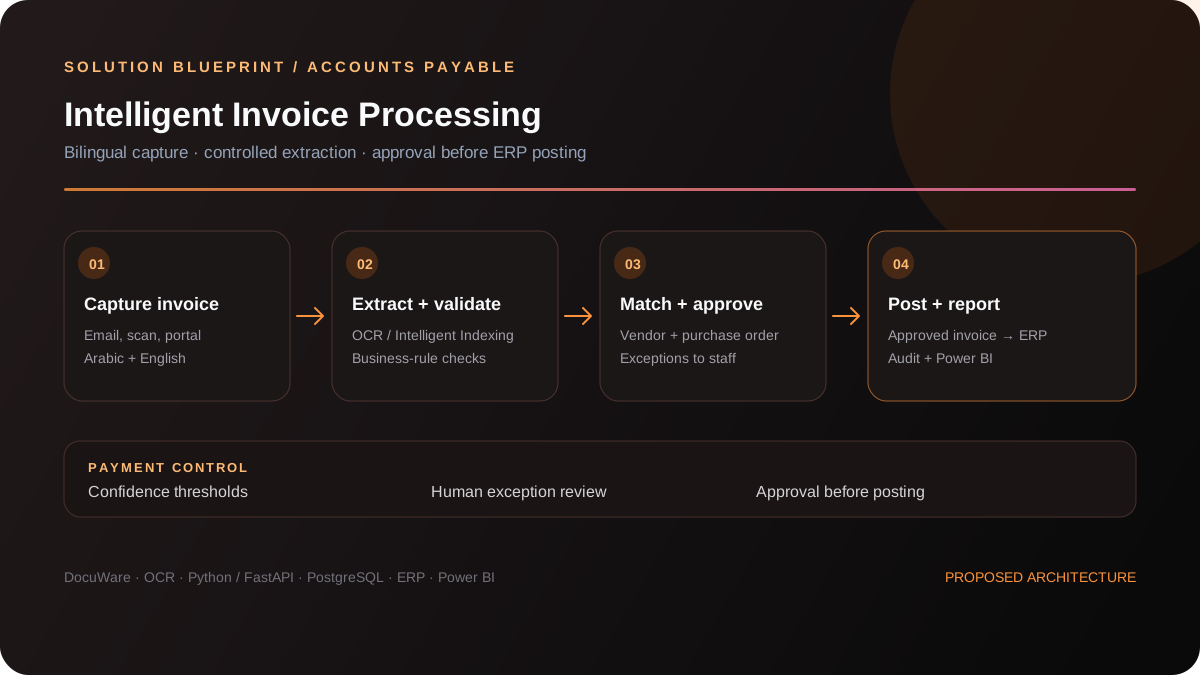
This case study proposes an accounts-payable workflow for supplier invoices and credit notes received as paper, scans, images, email attachments or portal submissions. OCR and AI-assisted extraction populate invoice fields; deterministic validation checks them against vendor and purchase-order data; configured approvals handle valid items, while exceptions go to staff. Approved records can then be posted to the ERP and monitored through operational reporting.
System Impact
Captures supplier invoices and credit notes from email, paper, scans and portals.
Validates extracted fields and matches suppliers and purchase orders before approval.
Routes configurable approvals, supports ERP posting and reports operational performance.
System Signal Flow
Architecture & Security Model
Visual Architecture Showcase
What sets this solution apart?
Handles bilingual invoices and multiple intake channels within one workflow.
Separates AI extraction from deterministic validation, matching and approval controls.
Uses confidence thresholds and human review instead of assuming every document is suitable for straight-through processing.
Measures outcomes in a controlled pilot against an agreed baseline rather than presuming savings.
Controls and Human Oversight
Low-confidence AI output is not posted as an invoice; uncertain, sensitive or high-value cases go to qualified staff.
Deterministic business rules and human approval remain in control.
Savings are not assumed in advance; the design calls for agreed baseline and pilot measurements.