ENTERPRISE CASE STUDY
Trade Document Sanctions Screening Solution Design
A proposed platform that extracts parties and shipment details from trade documents, checks them against versioned sanctions lists and risk rules, and prepares evidence for compliance officers.
Domain
Trade Compliance and Sanctions
Timeline
Proposed solution design
Architecture Role
Enterprise AI Solution Architect
Deployment Status
Business case and proposed architecture
Trade-screening evidence is spread across unstructured shipment documents and may contain Arabic and English names or inconsistent entity details. Manual review can be slow and inconsistent, while missed matches carry serious compliance consequences.
Extract and normalize relevant entities from each trade document, then run deterministic matching against client-approved, versioned sanctions lists and risk rules. Send potential matches to a case queue with source evidence and an AI-prepared summary for a qualified compliance officer.
Architecture Narrative
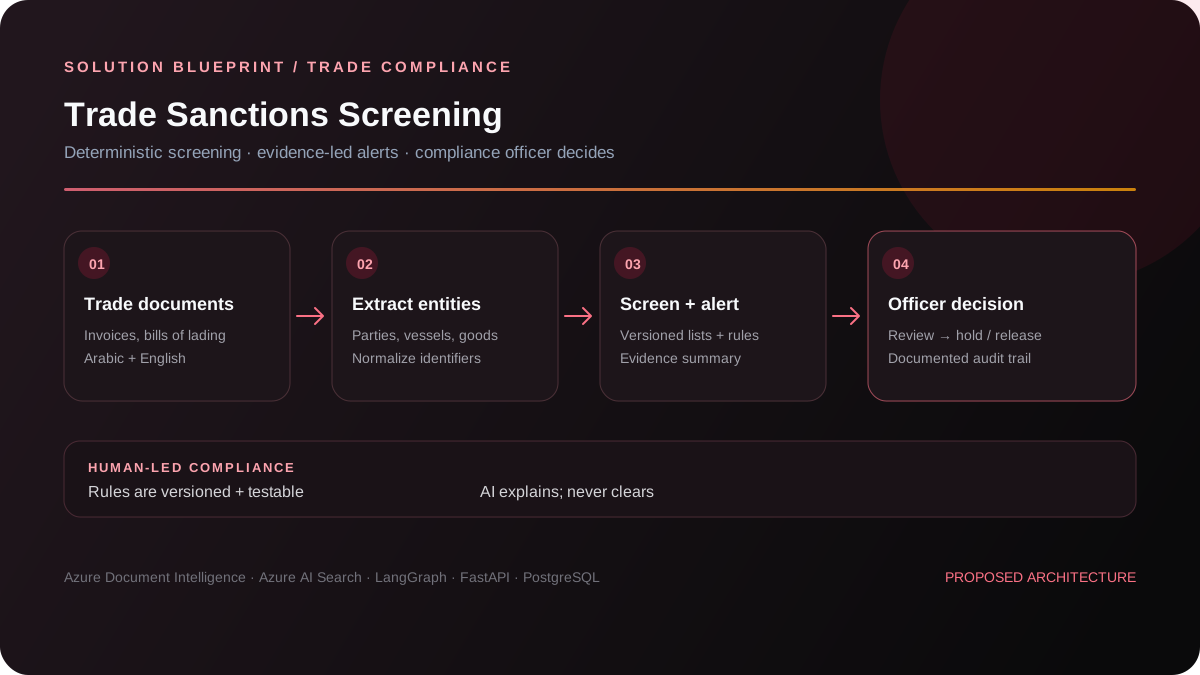
This case study proposes a trade-compliance workflow for invoices, packing lists, bills of lading, letters of credit, certificates of origin and customs declarations. Document AI extracts and normalizes entities such as parties, vessels, ports, countries and goods. A deterministic, versioned screening engine compares them with approved lists and rules, then prepares an evidence package for a compliance officer. The design supports investigation; it does not make legal or release decisions.
System Impact
Covers parties, banks, vessels, ports, countries, ownership links, goods and dual-use controls.
Creates traceable alerts with supporting evidence for compliance review.
Supports consistent screening of commercial invoices, packing lists, bills of lading and related trade documents.
System Signal Flow
Architecture & Security Model
Visual Architecture Showcase
What sets this solution apart?
Makes the matching rules deterministic, versioned and testable.
Presents evidence and document sources to help officers investigate potential matches.
Keeps list scope and applicable jurisdictions under the client compliance function.
Separates AI-assisted reading and explanation from the final compliance decision.
Controls and Human Oversight
Matching and scoring are deterministic, versioned and testable; AI explains evidence but does not decide matches.
A qualified compliance officer makes every decision; the AI does not clear or release a potential match.
Applicable lists and jurisdictions must be confirmed by the client's compliance function.