ENTERPRISE CASE STUDY
Voice Agent Solution Design
A proposed conversational voice agent for routine customer-service calls, using approved company knowledge and allow-listed low-risk actions, with performance measured after launch.
Domain
Conversational AI and Customer Service
Timeline
Proposed solution design
Architecture Role
Conversational AI Solution Architect
Deployment Status
Business case and proposed architecture
Routine calls consume customer-service capacity, callers may wait during busy periods, and traditional IVR menus can be difficult to navigate. When calls are transferred without context, customers may need to repeat themselves.
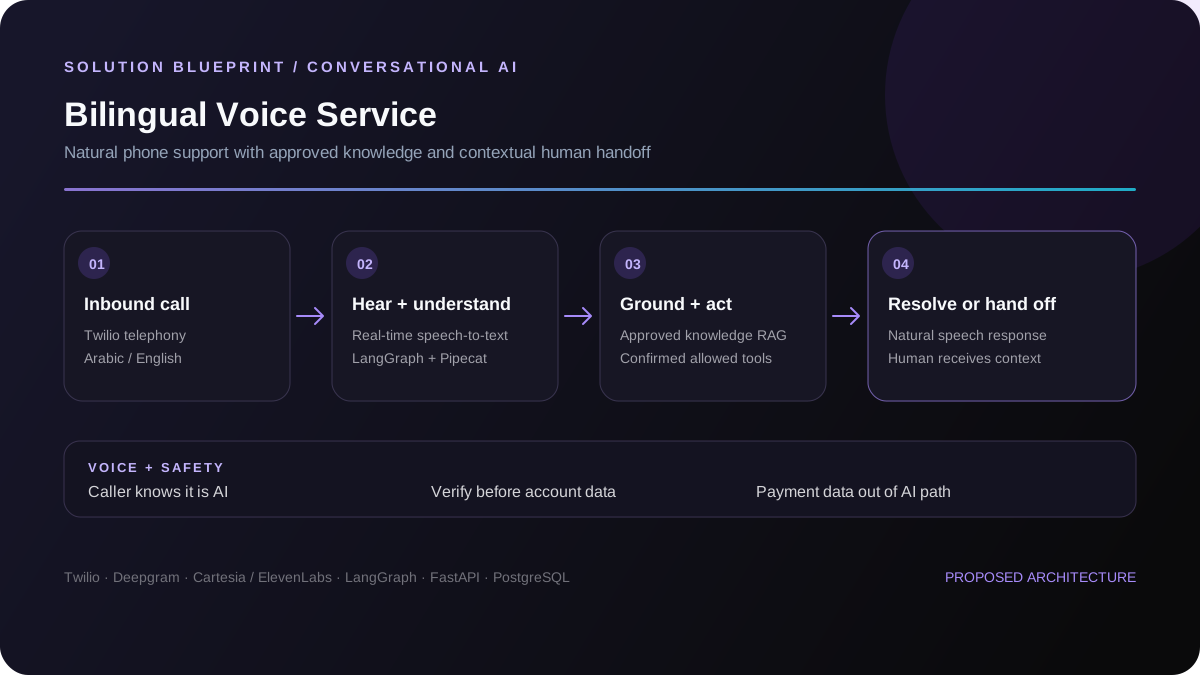
Provide a conversational voice interface connected to approved knowledge and a narrowly allow-listed set of low-risk actions. Use a real-time speech and dialog pipeline, verify identity before exposing account data, and transfer complex calls to a human along with a concise interaction summary.
Architecture Narrative
This case study proposes an inbound conversational voice service for routine customer requests such as policy questions, opening hours, order status and appointment booking. A real-time speech pipeline feeds a dialog orchestrator that retrieves answers from approved knowledge and may call allow-listed low-risk tools. The agent confirms permitted actions aloud and hands sensitive, unclear or out-of-scope calls to a human with context. Post-call metrics provide a basis for controlled improvement.
System Impact
Answers routine inbound questions using approved company information.
Can perform defined low-risk actions through connected systems with confirmation.
Hands calls to a human agent with context when the request needs escalation.
System Signal Flow
Architecture & Security Model
Visual Architecture Showcase
What sets this solution apart?
Combines speech recognition, dialog orchestration and natural speech responses in one call flow.
Grounds routine answers in approved company knowledge rather than unrestricted model output.
Supports Arabic and English while measuring performance by language and dialect.
Treats human handoff, caller disclosure and payment-data isolation as core workflow requirements.
Controls and Human Oversight
Callers are told they are speaking with an automated assistant.
Unclear, sensitive or out-of-scope requests are handed to a human with conversation context.
Account data requires identity verification, and payment-card data stays outside the AI path.