ENTERPRISE CASE STUDY
Enterprise Automation Delivery Specification
A reviewed technical delivery specification covering finance, marketing, records, tender, service productivity and dashboard/e-form workflows. The document distinguishes original portfolio descriptions from recommended enhancements; it is a blueprint, not evidence that every recommendation is deployed.
Domain
Enterprise Workflow Automation
Timeline
Delivery specification review
Architecture Role
AI Automation Solution Architect
Deployment Status
Reviewed delivery blueprint
The portfolio described valuable workflows but did not consistently distinguish deterministic rules from AI-assisted work, identify implementation modules, or define measurable acceptance criteria. Some tools and security choices also required owner confirmation.
Structure the material as a buildable specification: map each workflow, list its data and integrations, identify rules and exceptions, define review controls, and provide a delivery order with measurable acceptance tests. Clearly label enhancements as recommendations rather than delivered functionality.
Architecture Narrative
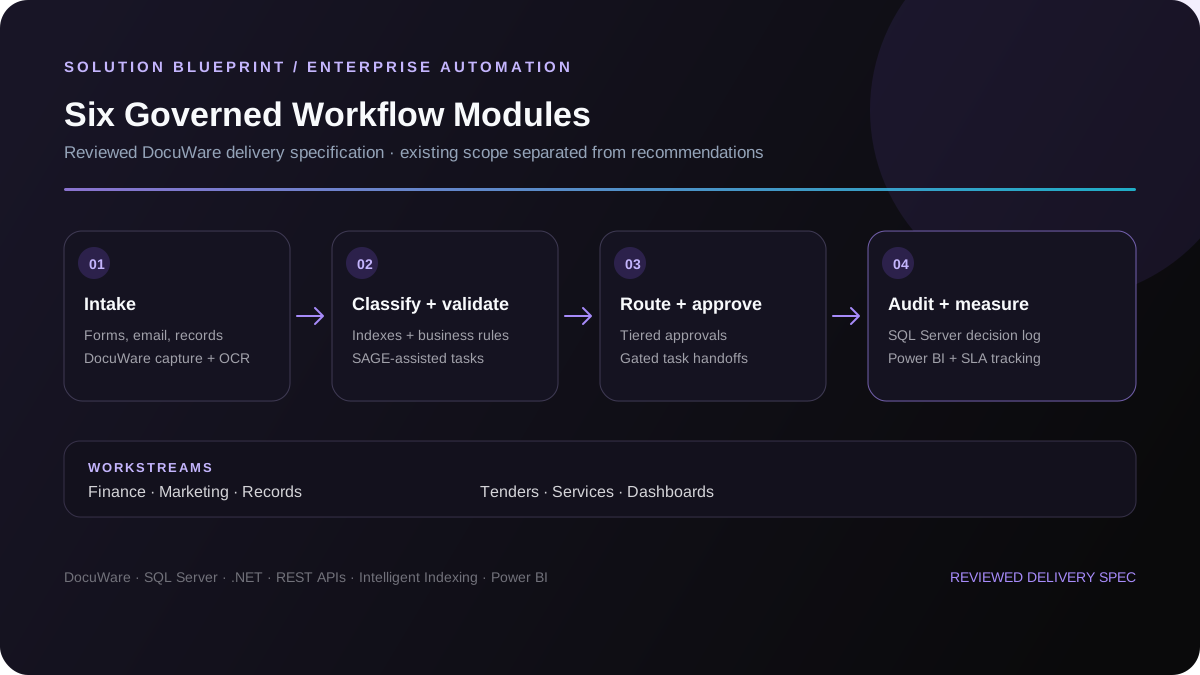
This case study turns an existing enterprise-automation portfolio into a reviewable delivery blueprint. It separates described capabilities from recommended enhancements and organizes six workstreams: finance invoices, marketing requests, digital records, tender coordination, service productivity and operational dashboards. DocuWare provides document and workflow services, SQL Server stores operational data and decision history, .NET services integrate systems, and a shared SAGE agent coordinates the AI-assisted steps described in the specification.
System Impact
Invoice workflow: capture, OCR, classification, validation, tiered approval and SLA escalation.
Marketing and records: classify requests, route tasks, auto-index documents and trigger contract-expiry reminders.
Tender, service and reporting: coordinate gated tasks, calculate productivity from task logs and surface KPIs.
System Signal Flow
Architecture & Security Model
Visual Architecture Showcase
What sets this solution apart?
Covers six connected business workflows instead of treating automation as a single undifferentiated feature.
Separates rule-based calculations and routing from AI-assisted document interpretation.
Makes the boundary between existing portfolio statements and proposed enhancements visible.
Adds a practical path from discovery and data-model confirmation through build, testing and rollout.
Controls and Human Oversight
The source document labels existing portfolio descriptions separately from recommended enhancements; recommendations should not be described as deployed without verification.
Business rules and calculations remain deterministic where the specification calls for rule-based processing.
Confirm open owner decisions and security details before treating the specification as an approved build baseline.